 |
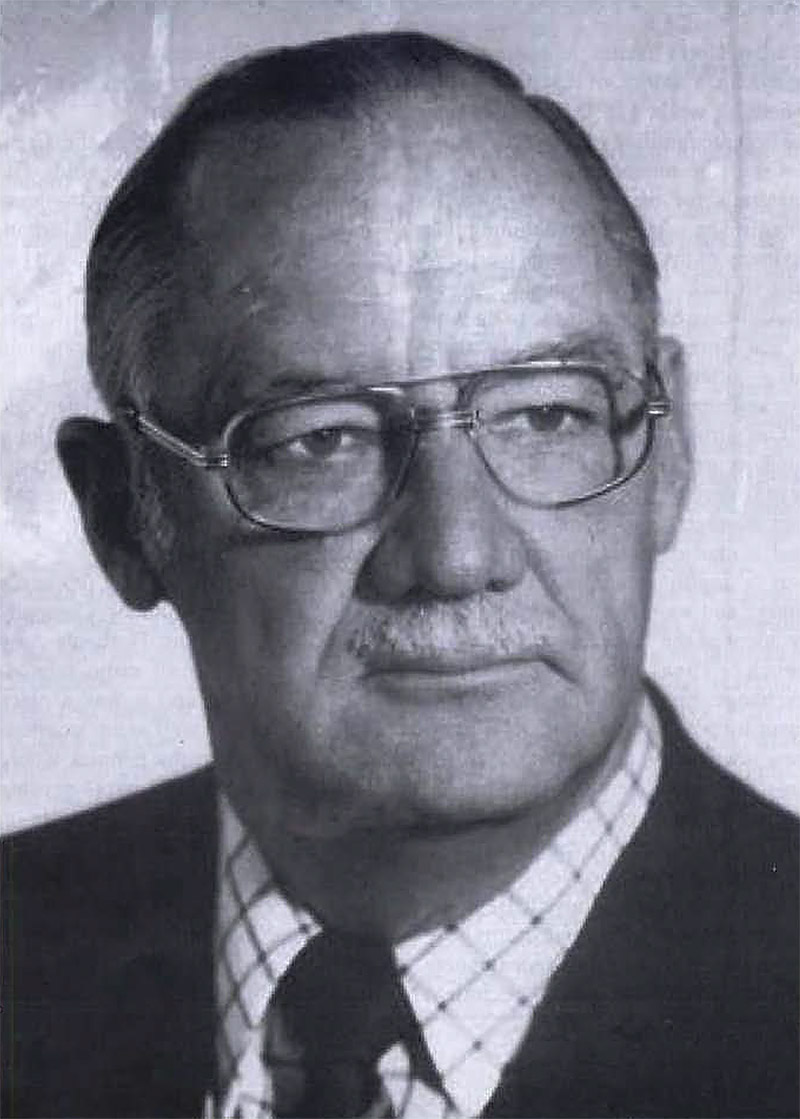
Horace Dainty retired in 1976 as Chairman of Racal Electronics South Africa. His death, just before Christmas, at the age of 90 brought to a close an era of radio manufacturing that began in 1935 when he established the first radio factory in South Africa and, most probably, in the whole of Africa. But he was no mere industrialist. This account of his life is an attempt to pay tribute to a remarkable man who faced adversity as if it was just another hurdle to be taken in his stride. Of Kitchener’s Fighting Scouts Horace’s father was always known as Captain Dainty since his days as adjutant of Kitchener’s Fighting Scouts, one of the irregular units raised during the guerrilla phase of the Boer War. This colourful outfit under the command of the big game hunter turned soldier, Lt Col J W Colenbrander, fought the Boers across the widest reaches of South Africa and always from the saddle. Though Dainty senior was no youngster, having been born in Easton on the Hill near Peterborough in 1859, he rode and fought with the best of them and his tales of derringdo enthralled his son many years later. But tragedy struck when the young Dainty was just 13. Already having lost his mother, his father died and Horace went into foster care. He also had to abandon his schooling because making ends meet became rather more important in the short term. Working first as a storeman he soon used a natural prowess for figures to become a competent bookkeeper. But his friends always remembered him as the boy he could do things with electricity and, even more amazingly, with wireless. Then South Africa was plunged into the depths of the Great Depression and Horace, like thousands of others, was out of work. Years later when Dainty’s name was part of the fabric of the military communications industry, both in South Africa and in England, he used to attribute many of his achievements to good luck but others who knew him saw much more to it than that. There was an inner steel to his make-up that never lost its edge and he had the courage to face any challenge no matter how daunting it seemed at the time. Something of Kitchener and Colenbrander had rubbed off on him too. Africa’s first radio factory At the age of 19 with no experience of the trade other than what he’d taught himself by assiduous self-study, Horace Dainty opened a radio factory in Johannesburg. It manufactured radiograms of essentially his own design and they soon found a ready market amongst the citizens of the Reef. But like many ventures with insufficient capital the business foundered and in 1938 he returned to his birthplace in Durban. There fortune seemingly smiled upon him and he bought The Radio Electro-Equipment Company that sold components to the now burgeoning radio industry around the country. He also offered a service to local radio amateurs by designing and building transmitters to order. Business was good and Horace was in his element. On 6th September 1939 South Africa declared war on Germany and Dainty like thousands of his compatriots wanted to do his bit. He knew from the time he’d served as a volunteer in the Natal Mounted Rifles during the height of the Depression that the Union Defence Force (UDF) had precious little by way of radio equipment and so he sent a cryptic telegram to the Postmaster General. “Can make transmitters”, it said. At that time, the PMG’s department acted as technical advisers to the South African Corps of Signals and the response to the Dainty telegram was almost immediate. A 150W transmitter was needed urgently in Port Elizabeth for communicating with the Royal Navy in the Indian Ocean. Such a device was well within Horace Dainty’s capabilities as it matched many of the amateurs’ needs and the components were all in stock. Within just a few weeks he personally delivered the transmitter, by courtesy of a flight in a South African air Force (SAAF) Junkers JU52. Soon afterwards the SAAF itself ordered a number of these transmitters for its various aerodromes around the country and then, their confidence bolstered by their performance, they placed an order for special vehicle installations based on RAF specifications. Three lorries were to be fitted with transmitters, receivers and the necessary power supply facilities and soon the road outside The Radio Electro-Equipment Company was full of vehicles being worked on, day and night, by Dainty’s staff. These mobile installations first went into action in Kenya from where the UDF was engaging Mussolini’s forces in Abyssinia. After winning that battle the South Africans moved further “up North” and Horace Dainty’s radio vehicles, which soon became nine sets of installations in total, saw service all the way from Egypt to Tripoli. M17s for the Army The 2nd South African Division was equipped with Marmon-Herrington armoured cars then being manufactured all across the country. The intention was that they would be fitted with Collins18M transceivers to be supplied by the USA but the exigencies of war and other priorities intervened and all of a sudden the UDF was informed that their 400 sets would not be forthcoming. They turned immediately to Dainty and the M17 was born. This 30W, AM and CW transmitter and receiver was designed in double quick time by Horace himself and manufacturing commenced in new premises close to Durban’s docks and under a new name. SMD Manufacturing came into being following an injection of capital from Messrs Steele and Matson, agents in Durban for many suppliers of electronic components. Horace Dainty’s initial now appeared on his company’s paperwork for the first time. Externally the M17 looked very similar to the 18M and was of exactly the same size since all the fittings to accommodate the US set were already in place in the armoured cars. But internally it was a different beast and reflected the skills and ingenuity of its designer who faced numerous problems along the way. A minor crisis was averted after the freighter that was carrying the special vernier dials, as well the variable capacitors for transmitter and receiver tuning, was torpedoed just off Durban. Undaunted, Horace enlisted the support of the South African Railways Workshop in Johannesburg who turned out superb replicas of the American slow motion dials while SMD, with the assistance of a local machine shop, made the 1200 variable capacitors required. The M17 met all the specifications and the sets were delivered to the Army as fast as SMD could turn them out. The Marmon-Herringtons, suitably equipped with radios, were then shipped to Egypt. But unknown to Dainty at the time was the decision taken by someone, clearly not well versed in the radio art, who decided to fit the short vertical antennas mounted on the armoured cars without their inductive loading. Needless to say, an already compromised antenna became well nigh useless and the range of the M17 was severely compromised – much to the chagrin of its operators. This would soon change once Dainty himself arrived “up North”! In Uniform By late 1942 the UDF’s Directorate of War Supplies was in full swing and consolidation of the various suppliers of equipment became a priority. So did bureaucracy and SMD had to move to Johannesburg. By now most of the UDF’s radio equipment needs were being met by British-supplied hardware so SMD’s role had changed significantly from the days when informality was the order of the day. Reams of paperwork soon became the norm. Horace Dainty decided he could be of more service elsewhere so he approached the Director of Signals (Colonel Freddie Collins) and asked if he could be released from his reserved occupation and be allowed to join up. Collins readily agreed and Second Lieutenant Dainty, without the benefit of an officer’s course, reported to Pretoria and the 17 Armoured Brigade Signal Squadron then being formed as part of the 6th South African Division. The only other officer then in the Squadron was the acting OC (Bert Howes, who would become Director of Signals after the war) while men filtered in from various directions, many having already seen service in the South African Tank Corps. With him Horace had four of his technicians from the early days in Durban. After some initial training and familiarisation, 6 Div sailed for Egypt in April 1943. They spent the better part of the next twelve months in training at Khatatba some 30 miles west of Cairo. There, as Bert Howes described it to the author, “we had to train a hotchpotch of humanity and turn them into signallers of all necessary trades etc”. There were just over 2000 of these “souls” and Dainty was given the task of producing radio mechanics while Howes, to his horror, got E & M. Their day started at 0600 and carried on with lectures and instruction, often with the same material being repeated thrice in the morning and again in the afternoon. This went on until late at night after which they let off steam! Early in 1944, 6 Div proceeded to Italy as part of the US 5th Army with Horace Dainty as TMO while Signals itself was under the command of Lt Colonel W G Perkins, who, years later, would work for Horace in Pretoria. In Italy the South Africans fought as motorised infantry with tank support. The ubiquitous WS No19 provided the radio communications and Dainty’s task was to keep serviceable around about 300 to 400 of them, scattered amongst the various regiments under command. All sets for repair were supposed to be sent back to Division but to someone who was rather used to making things happen much closer to home Dainty disregarded this injunction. After “winning” a couple of 3-tonners, one of which he set up as his workshop, the other as a battery charging vehicle, he deployed himself with the approval of Col Perkins as centrally as the battle would allow within 6 Div’s operational area. From there he operated independently of higher command and kept all regiments well supplied with No 19s in tip-top condition by always having at least one good set in reserve in his vehicle. Being in close proximity to the US Army afforded many opportunities to be impressed by the facilities on offer. But occasionally he was able to return the favour when the wireless repair skills of his Johannesburg-trained signallers brought the Yanks back into operation far sooner than even they had thought possible. Horace Dainty had a “good war”. While waiting in Bologna to return to South Africa many months after VE Day, he was informed that he’d been awarded the MBE. And he’d even managed to collect as a wireless memento a lump of rock from the driveway to Marconi’s palatial residence, the Villa Grifone, as 6 Div had lumbered past. SMD, Wadley and Racal Immediately on his return to Durban, Dainty set about resurrecting his business while South Africa itself returned to a peacetime economy. Import restrictions were tough and non- essential items such as domestic radio receivers were soon in short supply. So SMD stepped into the breach and began to manufacture them. But the real break-through came in the late 1940s when Trevor Wadley, an engineer at the Telecommunications Research Laboratory (TRL) in Johannesburg, invented his remarkable drift-cancelling receiver with continuous tuning. Though initial reactions to it from the Ministry of Supply in England were lukewarm, the BBC expressed interest in acquiring a number of receivers for monitoring purposes. In South Africa the UDF were decidedly interested as long as the sets were manufactured locally. In 1952 SMD won the tender to manufacture six production prototypes. What happened next is one of those milestones in technological history. Two of the Wadley receivers were taken to Racal, the fledgling radio communications company in Bracknell, where they were demonstrated to representatives of the Royal Navy. Since the RN’s plans to acquire the Collins 51J-1 for surveillance applications had fallen through there was now a desperate need to find a suitable replacement. It was soon apparent that Wadley’s receiver fitted the bill on almost every count and a contract was awarded for its production. What materialised in 1954 was the famous RA17 receiver, soon to be recognised as the best HF communications receiver in the world at that time. It was now clear to Dainty, and to the UDF, that SMD could not compete with Racal when it came to manufacturing the Wadley receiver but Dainty saw other opportunities closer to home which his small company could certainly exploit. The weather bureau in Mozambique required rugged AM transmitter/receivers for use throughout that large Portuguese-governed territory. SMD soon designed what was called the FSR 26 radio-telephone to meet the need and it too was ahead of its time in that, except for transmitter power amplifier, it was fully transistorised. Then the SMD-designed RT422B 100W SSB transceiver went into service throughout southern Africa when SSB was a mode of transmission hardly known anywhere else. It too made extensive use of solid-state circuit techniques and not only was it extremely simple to operate but it was rugged and highly reliable and, of course, was considerably more effective than AM equipment of similar power. Soon there were more than 600 RT422Bs in use and SMD had essentially captured the radio communications market as far north as the equator. But there was even more to come. In the early 1960s David Larsen, SMD’s chief engineer, designed what was arguably the world’s first SSB HF manpack, the RT14. The Racal company, already perturbed by their inability to penetrate the southern African market, were rather taken aback by this 25W SSB set on a man’s back that incorporated some radically new electronic features. Field trials, which Racal soon conducted in Malaya, were a resounding success when compared with the standard AM equipment then in service with the British army. These convinced the company to develop the RT14 (by now known as the TR28 in South Africa) as the TRA 906, or Squadcal, and then to market it aggressively. In all, more than 25 000 were sold to the military forces in the Middle and Far East but none was acquired by the British Army! From Racal-SMD to Racal South Africa In 1963, SMD joined forces with Racal and the company moved its facilities to Pretoria. The collaboration was very successful with Racal-SMD manufacturing various items of British-designed equipment as well as their own homegrown products. Soon Racal increased its share holding and the company became Racal Electronics South Africa (RESA) with Horace Dainty as Managing Director and David Larsen as its Technical Director. In keeping with his own inventive approach, Dainty employed highly talented electronics engineers and RESA maintained its position at the forefront of military communications. In 1965 it developed, on contract to the South African Defence Force (SADF), one of the first fully synthesised SSB/FM VHF manpacks, the SA-50X. This was followed within a few years by synthesised HF SSB equipment of which the 100W mobile and fixed station, the TR15, became the HF backbone with both the South African and Rhodesian forces. Soon, it would be eclipsed by an even more remarkable South African development when the world’s first frequency-hopping SSB transceiver, the TR15H, was unveiled in Pretoria. When Horace Dainty handed over the reins as MD to David Larsen in 1972 his company enjoyed a formidable reputation and was recognised by Racal International as one of the main reasons why the British company dominated the world of military mobile communications. The collaboration continued until 1977 when international pressure caused Racal to reconsider its options in South Africa and finally to withdraw. By then Horace Dainty had retired to become a sheep farmer back home in Natal. Profile: Brian AustinBrian Austin is a retired senior lecture from the Department of Electrical Engineering and Electronics at the University of Liverpool. Born and educated in Johannesburg, he graduated from the University of the Witwatersrand in 1969 and then spent the next ten years in industry working mainly on radio communications underground in mines. He returned to academic life, first at his alma mater and then, after emigrating with his family to the UK, at Liverpool. He did his national service in the South African Corps of Signals and then served for nine years in the Citizen Force (TA equivalent), retiring as a major. |
|
|
| Home | Diary | Contents | Search | Shop | Contact US | Donate |
| © Facts About Durban 2018. |